An ethical comparison of music streaming services
November 23, 2025 - Written by Andreas
Recently, I was re-evaluating the services I use. This got me thinking about my current music streaming service, Spotify, and whether they were “good” in the sense of artist payout, data privacy, and morals. I tried to look for a comparison online, but most of these focus on song availability, price, and sound quality. However, I feel like these are similar for most services. Therefore, in this article, I will be trying to compare different music streaming services on a different set of criteria: region of operation; artist payout; data policy; AI policy; and ownership practices.
Meet the candidates
I will be covering a number of services in this article. Alphabetically, these are: Amazon Music, Amazon’s streaming service; Apple Music, Apple’s take on music streaming; Deezer, a French service, Qobuz, also a French service; Spotify, the most popular one; Tidal, a Norwegian-American streaming service; and YouTube Music, Google’s attempt at making a music streaming platform.
I will go by every criterion and attempt to compare these platforms. This is not trivial as much of this information is difficult to access or has to be inferred, but I’m giving it a shot. At the end of the article, I will try to summarise all of this (in case you want a TL;DR).
Region of operation
In this section, I want to find out where each platform’s headquarters are and where major shareholders come from, if applicable. To me, this is relevant as different regions have different laws, e.g., regarding data privacy, but also as I personally find it important to support European companies.
Amazon Music is (obviously) owned by the American giant Amazon, and similarly, Apple Music is owned by Apple and YouTube Music is owned by Google.
Deezer is French but is owned partially by American, Russian, and Saudi-Arabian firms (e.g., Access Industries; Kingdom Holding Company)1. Qobuz is French and is entirely owned by Xandrie SA, a French multimedia and entertainment company. Spotify is Swedish, but is publicly traded and has major American investment firms as shareholders, e.g., BlackRock2. Tidal is originally a Norwegian service but is now majority-owned by Block Inc. (American).
Artist payout
Another important point in this comparison is artist payout. Artists like Taylor Swift, Damon Krukowski, and Chappell Roan have been voicing their concerns about this issue, which is especially affecting developing artists3 4. Most platforms do not provide direct numbers, so I’ve had to go hunting for some sources.
It is difficult to get precise numbers, so I’ve based these estimates off three sources5 6 7. However, I checked whether other websites mentioned similar amounts. This yields the following ranges: Amazon Music pays $0.004-$0.0096; Apple Music pays $0.0061-$0.007; Deezer pays $0.0048-$0.007, Qobuz pays $0.0136-$0.043; Spotify pays $0.0029-$0.005; Tidal pays $0.0068-$0.0127; and YouTube Music pays $0.0027-$0.0048. I thought a graph might be a bit easier to see:
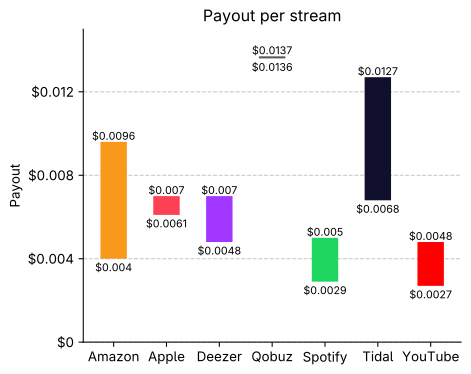
I’ve tried to assemble an average from other sources, but depending on the time it was created, wildly different estimates are given. Usually, the trends are in line with these data. The difference in amounts paid within a service depends on their distribution model and how much the user’s subscription type depends on the payout for the artist.
Unfortunately, this is not as clear as it seems. Streaming platforms do not pay the rightsholders an amount per stream, but this depends on other factors as well. Furthermore, the rightsholders may take their share, leading to an artist getting a lot less. Finally, it depends a lot on the artist’s location. It’s a rather complicated topic, but some services (such as Spotify and YouTube Music) are known for their low payout rates, and others (such as Tidal and Qobuz) are known for better payout rates. Of course, this also depends on (changes in) leadership, as happened with Tidal recently8.
User data policy
Another aspect dear to my heart is the use of your data by the companies and services. How much data do they collect and what do they do with it?
The terms of use of Amazon Music9 mention they collect any “user content” (your profile, your playlists, liked songs, comments, etc.) and have exclusive and irrevocable rights to do with that as they please—including sharing it with them and “sublicencees” in connection with “your profile” and “your use of services”. YouTube has very similar terms 10.
Apple Music’s privacy policy11 says they collect and use information about the music you play, how long you play it for, your library, but also information about how you use your device, such as the phone calls or emails you make. Apple says they collect this data to personalise your experience and to verify your trustworthiness.
Deezer’s privacy policy12 says they collect personal information (name, email address, phone number), streaming information (what you stream and browse), user content (photos and audio data), and your search history. They use this data to personalise your experience and to prevent fraud, so similar to Apple Music. With a subscription, you don’t get ads, but if you use their free version you can get ads—you can opt out of using your data for personalisation. Qobuz collects very similar data13 and also offers opt-out for third party sharing.
Spotify collects user data very intensively14, with lots of aspects of usage data (e.g., what music you listen to, browsing, search history, but also device information, devices on your network, and location). They use this to personalise your account, for marketing, and to “fulfill contractual obligations with third parties”. Like Spotify, Tidal also collects a large amount of user data and uses these for similar purposes15.
It’s difficult to decide which is most “private” to use, as these privacy policies are never exactly telling you what a service shares, and they might share more than we think. However, based on the information I have, I would make three tiers:
- Don’t use: Amazon Music, YouTube Music
- Lots of caution: Apple Music, Spotify, Tidal
- Caution: Deezer, Qobuz
Unfortunately, none of them does well in the data privacy department.
AI policy
Recently, Spotify was in the news as they decided to label AI music and introduce a new “music spam filter”. This is amongst allegations that they themselves upload AI-generated music and have bots “stream” these songs so that Spotify themselves earn more money16.
So far, Deezer is the only platform that tags AI-generated music and excludes it from user recommendations 17. As mentioned before, Spotify will tag them and YouTube also requires creators to disclose that music is AI-generated. The other platforms do not have such policies in place.
Ownership
The final aspect I want to look at, is ownership of the streaming services and their activities.
Amazon Music is obviously owned by Amazon, a US-based company known for its rather unethical practices18. They are known to evade taxes, abuse workers’ rights, violating user privacy, harming the environment, and harming small businesses.
The also-American Apple is also less-than-desirable for their contributions to climate change, possible tax avoidance, as well as poor labour conditions and possible child labour19 20.
Deezer’s major shareholder is Access Industries, a US-based investment company. They have holdings in natural resources, chemicals, loads of companies (including Isreali firms), and a load of technology companies (including Snapchat and Spotify)21. Deezer also has Saudi-Arabian investors22.
Qobuz is owned by Xandrie SA, a French multimedia and entertainment company. Xandrie is owned by the Thebaud Group, which is mostly investing in (French) entertainment and technology companies23.
Major Spotify shareholders are their owners, but also investment firms such as BlackRock, Baillie Gifford, and Morgan Stanley24. All these companies have the “usual” investment-banking controversies surrounding them, such as investing in fossil fuels, not disclosing information that should be disclosed, and investing in countries that are violating human rights (however, it must be noted these are likely also investing in other companies on this list, such as Amazon and Apple).
Tidal is majority-owned by Block, an American technology company mostly focused on financial products. I could not find too much about controversies, but the company does seem to be in an ongoing investigation for financial fraud25.
Finally, YouTube is owned by Google, which has similar issues to Amazon and Apple26. They perform badly in terms of workers rights, environmental impact, and tax conduct. Furthermore, they aggressively collect user data, violating their privacy.
So… which to choose?
Making a final decision out of this is difficult. I’ve compiled a table below that summarises the findings.
| Platform | Region | Mean Payout | Data | AI | Owner |
|---|---|---|---|---|---|
| Amazon Music | 🇺🇸 | $0.0068 | Avoid | No policy | Bad |
| Apple Music | 🇺🇸 | $0.0065 | Lots of caution | No policy | Bad |
| Deezer | 🇪🇺/🇺🇸 | $0.0059 | Caution | Tagging + no rec. | Bad |
| Qobuz | 🇪🇺 | $0.0136 | Caution | No policy | Seems okay |
| Spotify | 🇪🇺 | $0.0040 | Lots of caution | Tagging | Meh-bad |
| Tidal | 🇪🇺/🇺🇸 | $0.0098 | Lots of caution | No policy | Meh |
| YouTube Music | 🇺🇸 | $0.0038 | Avoid | No policy | Bad |
On the basis of ownership practices, we can exclude Amazon Music, Apple Music, Deezer, and YouTube Music.
That leaves us with Qobuz, Spotify, and Tidal. Qobuz and Tidal do much better in artist payout compared to Spotify, as well as ownership practices such as investors. Given that Tidal still has American ownership and their data collection is more invasive, Qobuz would be the least bad of all music streaming services compared here.
However, I hope it is evident from this comparison that music streaming is a dodgy business and is not a great way to support artists. If you care about ethical consumption and supporting artists, it is much, much better to support them directly. You can do this by buying their music either digitally or on your medium of choice or by buying their merchandise.
Personally, I like listening to music on CDs. This is a great way to support artists directly, plus, you could rip these files to your phone or computer. In combination with digitally buying your favourite artists’ music, you could even create your own digital library of music if you like listening to it on the go. However, that is a topic for another blog post.
I hope this blog post has given you a bit of insight into the ethics behind music streaming and different companies active in this area. I would love to hear your thoughts on this, and maybe any addition you might have—feel free to send me an email at mail [ at ] andreasknoben [ dot ] nl. Thank you!
https://www.usmagazine.com/entertainment/news/taylor-swift-and-more-musicians-whove-called-out-streaming-services/↩︎
https://www.pbs.org/newshour/show/musicians-push-back-on-dwindling-payments-from-streaming-services↩︎
https://www.statista.com/chart/26100/average-amount-of-streams-needed-to-reach-payout-of-dollar1/↩︎
https://www.isrc.com/how-much-streaming-services-pay-artists-per-play-2025.php↩︎
https://www.theguardian.com/technology/2025/mar/25/block-layoffs-jack-dorsey-cashapp-square-tidal↩︎
https://www.amazon.com/gp/help/customer/display.html?nodeId=Tn1MPX9QADK5mETFKJ↩︎
https://www.wired.com/story/spotify-ai-music-robot-listeners/↩︎
https://newsroom-deezer.com/2025/09/28-fully-ai-generated-music/↩︎
https://www.ethicalconsumer.org/company-profile/amazoncom-inc↩︎
https://www.culawreview.org/journal/child-labor-and-the-human-rights-violations-embedded-in-producing-technology↩︎
https://www.investopedia.com/news/top-3-spotify-shareholders/↩︎
https://bankingjournal.aba.com/2025/11/investor-sues-block-inc-founders-over-alleged-cash-app-fraud/↩︎
https://www.ethicalconsumer.org/company-profile/google-llc↩︎
Andreas' blog © 2025 by Andreas Knoben is licensed under CC BY-SA 4.0

